


Monterey: The Ultimate Guide To The Results of Monterey Car Week 2026

As Pebble Beach returns to its natural state as a golf course, as the masses head back to the airport and as the streets of Carmel no longer resemble a scene from a movie, it's time to look back on what we learnt from the auctions over Monterey Car Week 2026.
This post covers all the content we've produced from Monterey 2026, if you want to jump to a certain section, use the table of contents below to go right there.
Note: the analysis here focuses solely on the cars from Monterey, automobilia and bikes are excluded. Prices include premium. Estimate analysis does not include Mecum as no estimates are provided.
Table of Contents
Our Takeaways
1. The Strongest Monterey Ever
And by some margin. Cut it whichever way you want - Monterey 2026 delivered the strongest results we've ever seen.
Total sold vehicles reached c. $750 million, beating the previous record of $470 million in 2022 by 57%.
Sure, but was that just an increase in volume? The total number of cars offered stood at 1,068, a 5% increase on last year. The number of sold cars was up c.7%, which only partly explains the rise in average values.
Simply, it was more expensive vehicles being consigned and sold. Average sold vehicle value beat previous records, topping a remarkable $930,000. To put that into context, the average sold vehicle value in recent years has been around $500,000. That represents an unprecedented year-on-year shift.
Averages can be skewed by outliers and cars selling for incredibly strong money, of which there were plenty last week. Looking at it via the median removes those outliers - even in this instance, median values were up 19% vs last year.
Sell-through rate also remained very strong and indeed was the highest we've seen in recent years at 75%. A great indicator that buyer and seller expectations, at least in the US, are converging.
In other words, total sold value was at a record level, average sold price was at a record level and sell-through rate was the strongest we've seen for years.
But there's an important caveat here.
The auction houses had placed an intense focus on consigning more valuable cars. Median estimate values were up a staggering 45% vs last year. That's a huge shift in expectations from the auction houses - and importantly, one that buyers didn't entirely follow.
Median realised values were up 19%, less than half the increase in median estimates.
So what? Well, it tells us two things.
First, that 57% rise in total value is down in large part to the high-value halo cars crossing the block. There were simply more very expensive cars for buyers to bid on.
Second, the median rise of 19% tells a truer story. Monterey was genuinely stronger than last year, but it wasn't 57% stronger across the board. Auction houses were pricing the market aggressively, and buyers were willing to spend more - just not indiscriminately.
And that distinction is important. The market can be healthy without buyers being willing to pay whatever is put in front of them.
2. The Rich Get Richer
If there is one lesson to take away from the car market in 2026, it is the strength of the top end, particularly so with 6/7-figure 90s cars onwards trading for seemingly constant world records.
Monterey continued that trend.
Last year, the top 10 cars that sold at Monterey totalled $115 million. This year, the top 10 cars totalled $223 million - quite the rise. Side note: the sales total for Monterey in 2019 was $255 million. In other words, 10 cars this year almost amounted to the 2019 total.
Over 90 world records were set at Monterey 2026. We walk through many of those in our piece on The Top 10 Most Expensive Cars To Sell.
There's no denying that's a truly remarkable number. However, delving a little bit deeper, the story becomes more nuanced.
So, what have we got?
Circa 9% of cars sold at world-record prices. Based on the pre-sale estimates (excluding Mecum, as they don't publish estimates), 20% of cars offered were at world-record prices.
Sure, Mecum is a different offering and volume play, so it dilutes the number of lots at the world-record end of the scale. Even so, stripping out Mecum shows that 14% of lots sold at world-record prices compared to the 20% that were predicted beforehand.
Bear in mind that the estimate is an estimate of the hammer price and we're including fees here. The takeaway is that whilst plenty of records were achieved, buyers for the most part - putting the fridge to one side - refused to chase the majority of aggressive estimates.
And that's perhaps the most interesting thing about Monterey.
The buyers weren't simply throwing money at everything and that brings us to our next point.
3. The Delta Between Good and Great Widens
A trend we've seen all year has been the delta growing between the 'good' cars and the 'great' cars.
The premium someone is attributing to a unique spec, low mileage, fantastic provenance - whatever the reason - is becoming increasingly significant. If your vehicle has something to shout about, something very few (or ideally no other) cars can boast, then the market is willing to pay exceedingly handsomely for that privilege.
Monterey provided plenty of examples.
The very best cars? Absolutely. Buyers competed fiercely for those, often pushing them into record territory.
But when the car wasn't quite special enough, or the estimate was simply too ambitious, buyers were perfectly happy to walk away.
That's a healthy sign for the market. It suggests we're seeing genuine demand for exceptional cars rather than a return to an anything-goes mentality
This isn't particularly revolutionary - collectors have always paid a premium for exceptional cars. What's changing is the size of that premium.
With restoration and specialist labour costs at record highs, collectors increasingly pay a heavy premium upfront for finished, correct or preservation-grade cars to avoid the financial penalty of commissioning work later.
And when you consider the alternative, it makes sense.
Why buy an average example for $500,000, spend another $300,000 putting it right and end up with a car that's still only worth $600,000, when you can spend $750,000 on the exceptional example in the first place?
The market increasingly appears to be answering that question for us.
Good cars still sell. Great cars get fought over.
4. The Strongest Era Wasn't What You Thought, Kinda
If I was to ask you what the strongest decade was in terms of sell-through rate (STR) at Monterey, you'd probably answer the 1990s or 2000s?
The truth is it was the 1920s, with 30 of 34 cars selling - an 88% STR.
Next? Nope, not the 90s. It was the 1940s, with an 87.5% STR.
Next? Nope, still not the 90s. It was the 1910s, with an 87% STR.
These eras have typically always put their best foot forward at Monterey. Many of these cars are offered at no reserve and they're at far lower volume than the classics and modern classics, so you can caveat some of the above.
The truer indicator is perhaps how cars performed against their estimates - and the best-performing decade there was the 2000s, with 54% of cars selling above their top estimate (including fees). The 1980s were second strongest, followed by the 1990s.
At the other end of the spectrum, the 1960s took the crown for biggest underperformer, with 60% of cars selling below their lower estimate (including fees).
The pre-war cars performed reasonably well on these metrics, with 48% of all pre-war cars landing in the middle of their estimate.
And the story becomes even more interesting when you look at the major marques.
Among the popular makes we analysed, sell-through rates varied considerably. Rolls-Royce recorded an 86% STR, while Bentley and Alfa Romeo were both at 84% and Mercedes-Benz at 82%. Ferrari was at 71%, Porsche at 74%, Lamborghini at 67% and Shelby at 63%.
This isn't an exhaustive list of every marque at Monterey, so we're not suggesting one brand "won" the weekend. But it does reinforce the broader point: strength wasn't evenly distributed.
The market is increasingly discerning about what it wants - whether that's a particular era, marque, model or individual car.
5. A Crucial Caveat: Monterey's Place in the Global Market
Monterey isn't the entire market, and the market isn't Monterey. It's a crucial distinction to make.
From a volume perspective, Monterey makes up about 1% of all auctions annually. From a value perspective, it's so skewed to the top end that it isn't reflective of the broader market as a whole.
Furthermore, the US market often operates at a different level than its neighbours across the Atlantic; prices achieved here may not be attainable in Europe.
However, that doesn't stop us from taking signals from the colossal events of last weekend.
To summarise, here are the key headlines from the weekend's sales:
Monterey was genuinely stronger - but not 57% stronger: record headline sales were driven heavily by a much more valuable catalogue, while median realised values rose a still-impressive 19%.
The auction houses were more bullish than the buyers: median estimates rose 45%, but buyers didn't follow them all the way up. They were willing to spend, but not indiscriminately.
The rich get richer: the very best cars attracted extraordinary levels of competition, with the top 10 accounting for $223m of sales and over 90 world records achieved.
The gap between good and great continues to widen: exceptional specification, condition, provenance and originality are increasingly commanding a meaningful premium.
Modern classics continue to show pricing power: 2000s, 1980s and 1990s cars performed particularly well against estimates, while the 1960s were among the weaker decades.
Monterey is a signal, not the market: the real question is whether the strength seen among wealthy US collectors is filtering into the wider global market.
///////////////////
The Top 10 Most Expensive Cars To Sell At Monterey 2026
As mentioned above, it truly was a remarkable weekend at the top end. In 2019, the total sold value of all lots at Monterey was $255 million. The top 10 cars in 2026 sold for a combined $223 million... Here's the top 10.

10 - 2003 Ferrari Enzo
Estimate: $9,000,000 - $11,000,000
Sold: $10,675,000
Auction House: Broad Arrow
An Enzo is a wonderful thing, an Enzo in Nero is an even more wonderful thing. One of only a dozen U.S. cars in this colour. Classiche certified and meticulous documentation from new. 13,268 miles.

9 - 1985 Ferrari 288 GTO
Estimate: $9,000,000 - $11,00,000
Sold: $11,555,000
Auction House: RM Sotheby's
Gooding sold a 288 GTO this year for over $10,000,000 - the first time that's ever happened. Following Broad Arrow's sale of the Nero Enzo at over $10m - this RM car becomes the third example to join the $10m+ club. It's the 99th example and believed by RM to be one of only six 288 GTOs with sub-1,000 miles on the clock. Classiche certified (matching numbers engine and gearbox) and received a full mechanical overhaul between 2022 and 2024.
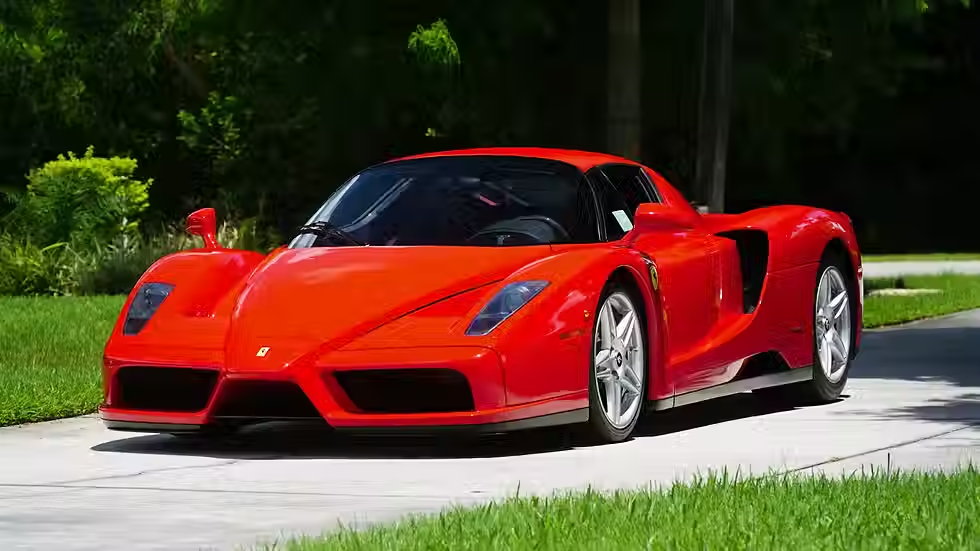
8 - 2003 Ferrari Enzo
Estimate: Not Provided
Sold: $12,100,000
Auction House: Mecum
Re-sale red. Classiche certified. US-spec Enzo. All fairly normal. Until you look at the odometer and see it reads 595 miles. That's why this Enzo just became the third most expensive example to ever sell publicly at $12.1 million.

7 - 1995 Ferrari F50
Estimate: $8,000,000 - $10,000,000
Sold: $12,105,000
Auction House: RM Sotheby's
This US-spec Classiche certified F50 is an ex-Mike Tyson car with 6,196 miles on the clock and was accompanied by the luggage, tools, manual and more. It made all the money at $12,105,000. It is now the third F50 to break the $10,000,000 mark.
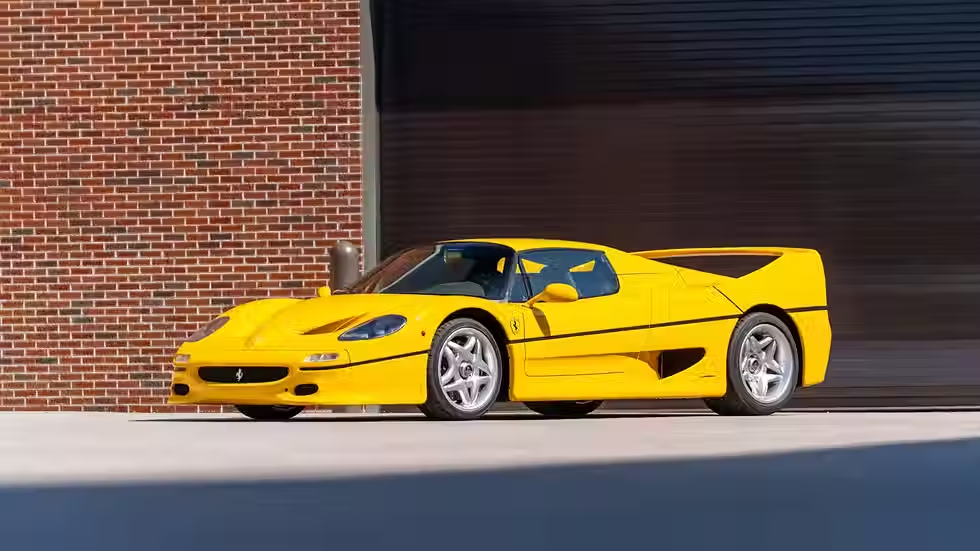
6 - 1996 Ferrari F50
Estimate: Not Provided
Sold: $14,575,000
Auction House: Mecum
The two big advantages this F50 had over the RM example was it being finished in Giallo Yellow (one of 31 in this colour) and having fewer miles (4,506 miles vs 6,196 miles of the RM car). Interestingly, this was delivered to Switzerland from new thus not a US-spec car. This example set a new world record price for an F50 at over $14.5 million.

5 - 2023 Ferrari Daytona SP3
Estimate: $10,000,000 - $12,000,000
Sold: $17,825,000
Auction House: RM Sotheby's
For many, including myself, this is top of the pile when it comes to the Icona Series. One of 600 produced, two owners and 227 miles from new. Broad Arrow sold a 460 mile example last year for under $7.5m. The Ferrari market is hot right now - let's see if the estimate can be reached.

4 (Tie) - 1963 Chevrolet Corvette Grand Sport
Estimate: $11,000,000 - $13,000,000
Sold: $18,705,000
Auction House: RM Sotheby's
In the Corvette pecking order this is very near the top. One of only five Grand Sports produced and with a globetrotting history, it's a passport and entry ticket to almost any event of your choosing. Someone was keen for that passport when it broke through its top estimate to sell for $18,705,000.

4 (Tie) - 1963 Ferrari 250 P
Estimate: $15,000,000 - $20,000,000
Sold: $18,705,000
Auction House: Gooding Christie's
The very first 12-cylinder mid-engined Ferrari was unveiled at Monza in March 1963. Pininfarina gave the car a wonderfully clean, sharp line with a roll-over hoop-cum-wing right behind the cockpit. The 250 P didn’t take long to establish its name on the track. So good was its performance, in fact, that it won Ferrari the Sport-Prototype World Title. This car is no stranger to the track having come second at Sebring in 1963, third at Le Mans in the same year. Raced by the greats including Luigi Chinetti’s N.A.R.T. it sold for a great price at $18.7 million

3 - 1996 McLaren F1 GTR
Estimate: In excess of $35,000,000
Sold: $34,655,000
Auction House: RM Sotheby's
The Pop Art F1. Ex-Nick Mason ownership. Chassis 10R is one of only two McLaren F1 GTR Short-Tail prototypes along with the 1995 24 Hour Le Mans winner (chassis 01R). The first of only nine McLaren F1 GTRs built to 1996 specification; the fastest and most desirable variant of the McLaren F1 GTR. Converted for road use by McLaren and maintened extensively by the wizards at Lanzante, it's a special vehicle. The last GTR to sell publicly did so in 2014 for a little over $5m, its been quite the rise to $34,655,000 today even if the car missed its estimate and had no competitive race history.

2 - 2026 Ferrari Luce 'Tailor Made'
Estimate: In excess of $1,100,000
Sold: $40,000,000
Auction House: RM Sotheby's
There's no debate which sale dropped more jaws to the floor. The Ferrari Luce, estimated at in excess of $1.1m, was Chassis 0 being sold with all proceeds to The Ferrari Foundation.
And it proceeded to climb, and climb, and climb. Finding its resting place at $40m.
Many claimed it was all about the tax write off. Not plausible, the tax write off on a purchase like this is c. $15m. Someone is going to pay $40m over a fair market value in order to save $15m - the math don't math.
Many claimed it was money laundering. The buyer Dr Hebert Wertheim is a billionaire with a clean history. Doesn't stack up.
The real reason turned out to be simple. Dr Wertheim has a history of significant donations to Universities and other similar organisations. Where do the proceeds of this sale go? The Ferrari Foundation which works in the education space - aligning perfectly with his prior charitable activity.
Notably, the Dr also was the purchaser of the SP3 charity lot last year which sold for $26,000,000.

1 - 1964 Shelby Cobra Daytona
Estimate: In excess of $25,000,000
Sold: $42,905,000
Auction House: Gooding Christie's
It was a good day for Gooding when Caroll Shelby's personal Daytona smashed all records when it became the most expensive American car to ever sell at public auction - breaking the previous record by over $20 million (also set by Gooding for a Deusenberg SSJ in 2018).
///////////////////
Top 5 Cars That Flew at Monterey Car Week 2026
Plenty of top end motors grabbed the headlines from the auctions in Monterey.
Perhaps the more interesting take though, and one that's not spoken about enough, is what cars over or underperformed. Here are the top 5 cars that exceeded their estimate in percentage terms.

5 - 1991 Rolls-Royce Corniche III
Estimate: $75,000 - $95,000
Sold: $184,800
Overperformance: 95% / $89,800
Auction House: Broad Arrow
One of just 122 U.S.-market examples produced in 1991 with a little over 16,000 miles on the clock. This two-tone Corniche III hit its top notes when it finished far beyond it's $95,000 top estimate, selling for $184,800 - a new world record for a Corniche III.

4 - 2004 Porsche 996 GT3
Estimate: $125,000 - $175,000
Sold: $351,500
Overperformance: 101% / $176,500
Auction House: Gooding Christie's
We've discussed previously how hot the 996 market is right now - another example just confirmed that. This single owner 9,700 mile example finished in Speed Yellow not only doubled its estimate but smashed through the previous world record for a 996 GT3 of $220,000 when this sold for $351,500 with Gooding Christie's.

3 - 1956 Volkswagen Beetle
Estimate: $60,000 - $80,000
Sold: $168,000
Overperformance: 110% / $88,000
Auction House: Gooding Christie's
Most Beetles lack oomf. This one doesn't, and in more ways than one. Power wise this example came with the rare Judson Supercharger. Beautifully restored with less than 700 miles, it was accompanied with a charming “Tag-A-Long” single-wheel trailer and various accessories. This also had the oomf to blast past its $80,000 top estimate by more than double selling for $168,000.

2 - 2020 Ligier JS P320
Estimate: $80,000 - $120,000
Sold: $313,000
Overperformance: 161% / $193,000
Auction House: RM Sotheby's
This LMP3 spec vehicle came to auction with an estimate of $80,000 - $120,000. It ripped through that in and sold including fees at $313,000. That's a 161% rise over the top estimate. Someone was very keen for a track day toy.
1 - 2026 Ferrari Luce 'Tailor Made'
Estimate: In excess of $1,100,000
Sold: $40,000,000
Overperformance: 3,536% / $38,900,000
Auction House: RM Sotheby's
There's no debate which sale dropped more jaws to the floor. The Ferrari Luce, estimated at in excess of $1.1m, was Chassis 0 being sold with all proceeds to The Ferrari Foundation.
And it proceeded to climb, and climb, and climb. Finding its resting place at $40m.
Many claimed it was all about the tax write off. Not plausible, the tax write off on a purchase like this is c. $15m. Someone is going to pay $40m over a fair market value in order to save $15m - the math don't math.
Many claimed it was money laundering. The buyer Dr Hebert Wertheim is a billionaire with a clean history. Doesn't stack up.
The real reason turned out to be simple. Dr Wertheim has a history of significant donations to Universities and other similar organisations. Where do the proceeds of this sale go? The Ferrari Foundation which works in the education space - aligning perfectly with his prior charitable activity.
Notably, the Dr also was the purchaser of the SP3 charity lot last year which sold for $26,000,000.
/////////////
Top 5 Cars That Flopped at Monterey Car Week 2026
We like to give a balanced, data-led approach at TCV. So it's only right that we highlight those cars that underperformed vs their estimate.
Let's dive in.

5 - 1940 Packard 110 Convertible Coupe
Estimate: $35,000 - $45,000
Sold: $13,440
Underperformance: 62% / $21,560
Auction House: Bonhams
Bonhams were always fighting an uphill battle on this one with prices for Packard 110s down more than half since pre-Covid. This no-reserve lot finished at $13,440 including fees, 62% below its lower estimate.

4 - 1928 Lorraine-Dietrich B3-6
Estimate: $400,000 - $600,000
Sold: $145,600
Underperformance: 64% / $254,400
Auction House: Gooding Christie's
Three of the top 5 biggest underperformers were from the Mullin Museum, after much of it being sold off the final remenants are now being worked through and typically the struggled to find the money desired. This example offered no reserve was a case of just that, selling for $145,600 - that's over $250,000 below its lower estimate.

3 - 2019 Toro Rosso-Honda STR19 F1
Estimate: $625,000 - $825,000
Sold: $224,000
Underperformance: 64% / $401,000
Auction House: Bonhams
F1 cars have been hot property in recent years. This Ex-Pierre Gasly and Alex Albon car which came 2nd at the 2019 Brazilian Grand Prix looked remarkably good value at $224,000 - $400,000 below its lower estimate. This example came with "much of its mecahnical componentry save for the engine" so whilst not a vehicle ready to take to the track with your support team it certainly doesn't classify as a typical show car. Well bought (providing you can source the engine).

2 - 1924 Chenard & Walcker T5 Roadster
Estimate: $250,000 - $350,000
Sold: $70,000
Underperformance: 72% / $180,000
Auction House: Gooding Christie's
Another ex-Mullin collection car which had been globe trotting from Australia where it was delivered, bodied and raced all the way to two UK collections and now sold in Monterey it's been a journey navigating life. The auctioneer managed to navigate this to be sold at $70,000 given it was no reserve.bidvb

1 - 1973 Citroën GS Birotor
Estimate: $20,000 - $30,0000
Sold: $5,600
Underperformance: 72% / $14,400
Auction House: Broad Arrow
This Citroen GS which formerly found its home at the Mullin Museum struggled to find anyone who wanted to be its new home. The car sold, but 72% below its bottom estimate.
It's also worth noting who doesn't appear in this list, RM Sotheby's. They didn't have a car that underperformed their low estimate by a big enough margin to feature in the top 5, top 10, top 20 or top 30. It took all the way down to 36th place before you reach an RM lot that underperformed enough to make the list.
There we have it, the ultimate guide to the most important classic car week in the calendar. It took us over 13 hours to pull together this article so if you enjoyed it, sign up to our newsletter here to be the first to receive these insights and more.
Feel free to share it with a friend, too!
Till next year...
Comments